



The rise in demand for electric vehicles (EVs) and battery powered devices is reshaping the global transport task, and ports are becoming more aware than ever of the heightened risk.
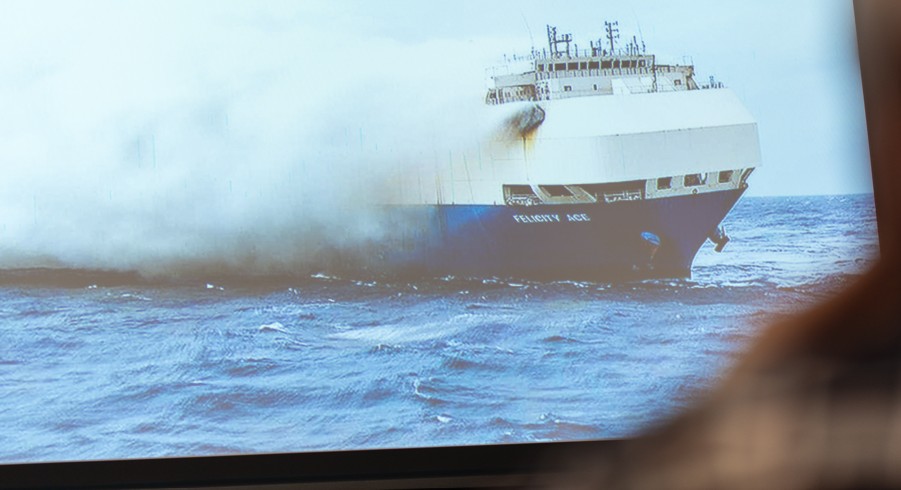
Overseas car carrier fires have shown how quickly these incidents can escalate, raising a critical question for Australian ports: are they prepared to respond to a lithium-ion battery fire at sea, alongside a berth or within port precincts?
Captain Savio Fernandes is the Harbour Master at Fremantle Ports and Chair of Ports Australia’s Port Operations Committee. In his interview for this article, Savio’s insights draw on work undertaken by the Committee, engagement with subject matter experts, and publicly available literature.
Savio says it was around COVID that risks associated with lithium ion battery fires first became a focus for ports, also coinciding with the increase in transportation of Battery Electric Vehicles (BEVs).
“We saw a surge in global EV trade and a series of high profile vessel fires overseas, which resulted in total losses once EV fires were involved,” said Savio. “A recent incident was on the ‘Morning Midas’ in the North Pacific Ocean, resulting in the vessel sinking at sea.”
“This has brought the issue into the limelight. While it’s a low-probability occurrence, it’s of extremely high consequence.”
Low probability, high consequence
Just as Savio notes, lithium ion battery fires are now widely recognised as a “low probability, high consequence” risk. While fires attributed to traditional internal combustion engines in cars have a greater probability of occurrence, the consequences of a lithium-ion battery fire, particularly one involving EVs, are far more severe. Once thermal runaway occurs, these fires generate extreme heat, release highly toxic gases and are impossible to extinguish using conventional firefighting methods. If a fire of this nature occurred on a RoRo vessel carrying EVs, the consequences could be catastrophic.
Adding to this concern, Savio explained that, at present, there is no reliable solution once an EV lithium-ion battery enters thermal runaway.
“From a ship crew survivability and port safety perspective, this creates a fundamentally different risk equation, one that extends well beyond the vessel itself if an incident occurs near or alongside a berth.”
Australia has not been immune to vessel fires. A RoRo vessel fire incident in Melbourne in 2023, while confirmed as not being ignited by an EV, demonstrated the complexity of managing fires on vehicle carriers. The vessel was ultimately extinguished using CO₂, evacuated, and remained alongside for almost 86 days, highlighting the operational and economic disruption such incidents can cause even when worst case scenarios are avoided. An EV related fire on a vessel within a port could have far greater consequences.
“Unlike fires from internal combustion engine cars, temperatures from EV fires range well above 1000 degrees centigrade,” said Savio. “Saltwater fire extinguishing systems, as well as freshwater systems, are incapable of handling such fires. The only real solution is to let them burn out. Those fires also generate toxic gases, which create even further consequences, from a risk to community perspective.”
Learning from international experience
Globally, the ports industry is still learning. International guidance for lithium-ion battery safety largely focuses on carriage at sea, developed by classification societies and insurers. However, even this knowledge has not always been well disseminated across ports and emergency responders, and there is far less guidance on what happens when ships arrive in port or when cargo is stored landside.
“Several overseas incidents have provided important lessons,” said Savio.
One of the few vessels to survive a major fire incident, a RoRo vessel called Delphine in Port of Zeebrugge, Belgium, did so because the fire was ultimately found not to involve an EV. Even then, the response highlighted the limitations of traditional systems such as CO₂ suppression, which is highly dependent on timing, temperature control and preventing the re introduction of oxygen.
Savio mentions that the Port Operations Committee has been in contact with the harbour master in Zeebrugge to learn from this incident.
“In that case, local fire brigades trialled an experimental approach of injecting liquid nitrogen to lower temperatures enough to safely open cargo spaces. And for them, that was the learning itself, even though it was experimental.”
The incident at Port of Zeebrugge also highlights the critical nature of involving first responders in the conversations with ports. At a Port Operations Committee meeting in late 2024, first responders from WA and QLD joined harbour masters and port operators from around Australia to further explore options for a coordinated response. The Committee identified that there were major gaps in understanding and guidance for response to lithium-ion battery fires, should an incident occur in Australian waters.
From ship to shore
The risk does not end once a ship unloads its cargo. If a lithium ion battery fire occurs while a vessel is berthed, or when vehicles and battery products are stored in port precincts, the consequences can rapidly extend beyond the water.
Nicola Murray is the Logistics & Project Cargo Manager at Port of Brisbane, and Chair of Ports Australia’s Logistics Committee. Nicola says that it wasn’t until Port of Brisbane started looking at scenarios around a lithium-ion battery incident that the port and stevedores started to identify opportunities to improve their processes.
“As we began seeing more batteries through the port, not just in EVs, but the kind used for storage to support large-scale energy projects, it became apparent that we needed to start talking about how we protect ourselves and our infrastructure from a serious incident,” said Nicola.
With these fires burning hotter and impossible to extinguish, there are real threats to port infrastructure once offloaded from the vessel.
Nicola explained that with so many points in the supply chain, it’s not just a matter of moving the batteries along quicker, but about developing tailored plans for each section of the process.
Once a lithium-ion battery enters thermal runaway, it cannot be extinguished in a conventional sense, and the safest option is often to isolate the area and allow the fire to burn out. However, the heat generated can be intense enough to damage wharf structures and port infrastructure. While there have been no incidents of lithium-ion battery fires in an Australian port precinct, incidents from overseas are cause for concern.
“As we started looking internationally for answers, what became clear is that everyone is grappling with this.”
Nicola says that guidelines for supply chain operators need to be specific and account for the Australian climate and infrastructure.
As Savio and the Port Operations Committee began looking into the feasibility of creating guidelines for Australian ports, Nicola and the Logistics Committee developed similar goals.

Prevention and response
Given the limitations of firefighting once thermal runaway begins, there is an increasing focus on prevention and early detection. Several major shipping lines have introduced measures such as restricting the carriage of second hand EVs, regulating battery state of charge, and investing in advanced monitoring technologies that detect changes in temperature or ambient conditions inside cargo spaces.
These technologies improve early warning and crew safety, but don’t entirely eliminate risk, especially once the cargo arrives in port.
“For carriage risk while at sea, there is already education happening around prevention,” said Savio. “But the focus is on prevention, not response. Current emergency management frameworks is an area that requires further development.”
“The Port Operations Committee has done work with fire brigades in Brisbane, and at Fremantle, we conducted a port safety exercise with our local fire departments. That was done in collaboration with an organisation called Global Port Safety, coming from France. We involved them so that firefighters were familiar with the way that ship systems are set up.”
The element of toxic gas, generated from batteries in thermal runaway, adds additional pressure on emergency processes to ensure community safety.
At Ports Australia’s BizOps Conference, held in Gladstone in late 2025, John Thomson, Senior Claims Executive at global insurance providers TT Club, noted that during an incident at the Port of Montreal involving a lithium-ion battery fire in a container, toxic gases posed a large threat to surrounding residents. He noted learnings from this incident included the timeliness of response.

Many Australian Ports have already started their own response plans.
“It’s something we’re trying to understand on the landside operations,” said Nicola.
“Our Logistics Committee were all raising these questions, so we decided that that a good start would be a guideline for ports to start making their own plans.”
Building the framework
In the past year, Ports Australia’s Committees have been working closely with fire authorities, scientists, insurers and international partners to close the knowledge gap and better understand both technical risks and real world response challenges.
Ports Australia’s Committees are now reviewing national frameworks already in place. Under the National Maritime and Dangerous Goods (NMDG) code, lithium batteries are classified as IMDG Class 9, which covers dangerous goods not specified in other codes.
“For example, in the code, explosives fall under IMDG Class 1, so we know exactly what is coming through the port. Whereas lithium batteries are coming through as miscellaneous dangerous goods. The Port Operations Committee believes that it requires a dedicated section for lithium batteries to help us manage that risk,” said Savio.
“We’re planning to put this in as a chapter under the guidelines we develop.”
Savio says the guidelines won’t have prescriptive directions for ports on how they manage these goods, but will help ports to develop their own strategies, fit for their operation.
“I’d like to see this guidance help ports develop robust response plans, without needing to be more prohibitive,” said Nicola. “We’re seeing more and more batteries through the port as demand increases, so that’s why we’re trying to come together to explore the issue and produce future-focused solutions.”
Nicola Murray will be attending the International Association of Ports and Harbours (IAPH) Technical Committee meeting in Singapore this month to present on this work from the Logistics Committee and spotlight the issue on the global stage.
“Having raised the topic of the handling, storage and transportation of lithium-ion batteries with the IAPH, it was pleasing to learn we are not the only port raising such questions, and it’s good to see this will now be an agenda item for discussion,” said Nicola.
An evolving challenge
Demand for BEVs and lithium-ion battery products is forecasted to grow. As new battery chemistries emerge, ports will need to remain adaptive.
Savio says the world is still catching up with the technology. He says informed, balanced decision making, without panic, is critical.
“Lithium-ion batteries are where the current concerns are, but you've got alternative battery solutions coming into the market, such as sodium-ion batteries. What's the risk profile with those batteries compared to lithium-ion? It’s unexplored territory.”
Ports Australia will continue working with its Committees to develop guidelines for ports and operators, to assist ports in developing strategies for managing lithium-ion battery risk and response.
Find out more about Ports Australia's Committees.


