


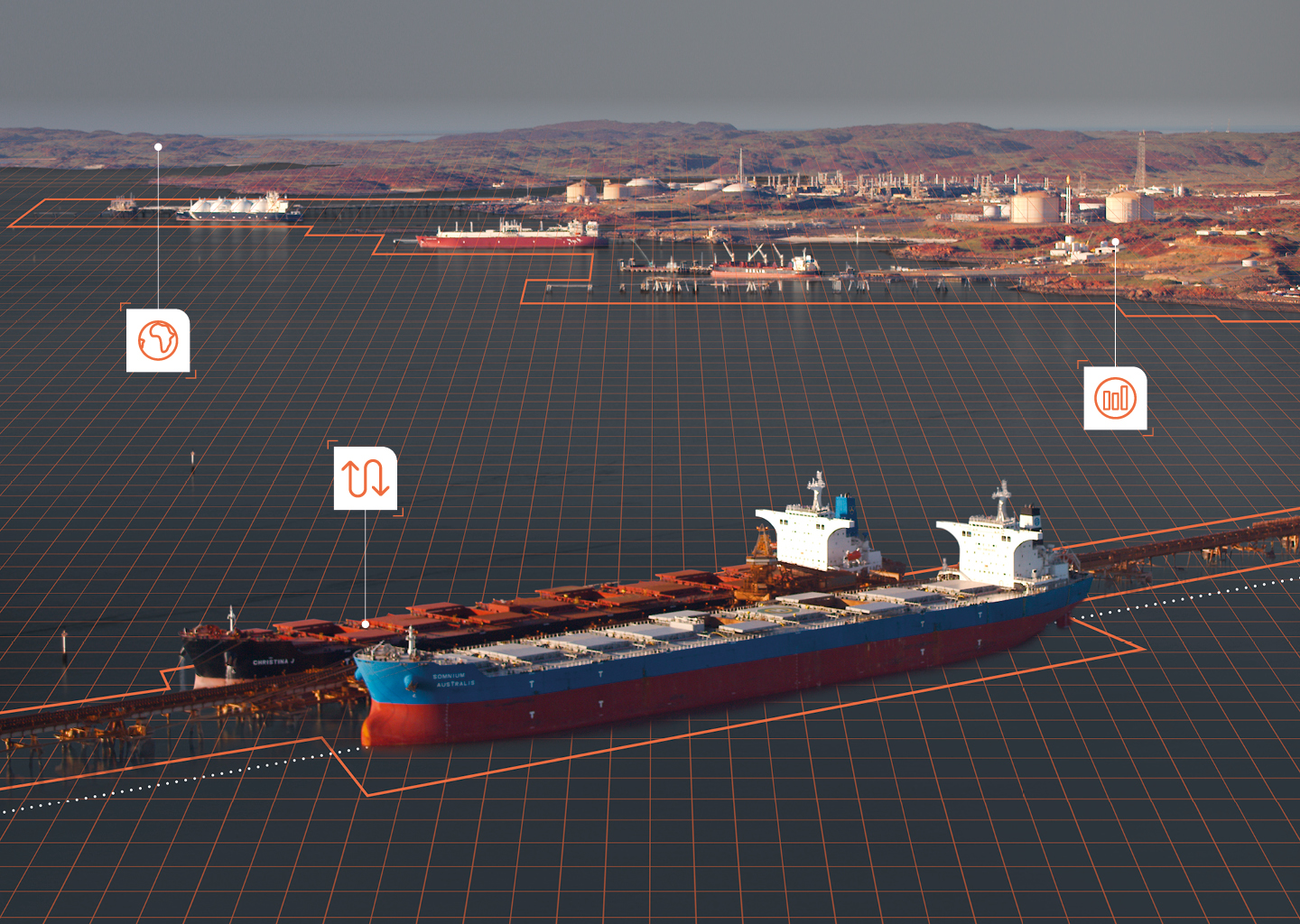

Ports Australia is pleased to welcome RightShip as a member of our network. Through intelligence, workflow and data, RightShip aims to empower ports with efficient risk management and achieve their sustainability goals.
Australia’s ports are busier than ever. According to our State of Trade report, Australia’s ports see around 31,000 cargo vessel calls per year and have seen a year-on-year rise that mirrors the global demand. The challenge for many ports isn’t just managing volume; it’s ensuring every movement is efficient, compliant, and sustainable.
Drawing on more than two decades of working with ports and terminals globally, RightShip has observed a fundamental shift in how safety, sustainability and risk are managed. Where decisions were once based on static reports, local knowledge or manual checks, ports today are expected to assess risk, safety and environmental impact using real-time data, shared platforms and increasingly automated workflows.
RightShip has shared with us some of the key insights emerging from that shift, including how technology and AI are reshaping port operations, why safety remains an under-recognised metric in data strategies, and what ports can do to better embed data into everyday decision-making.
Technology and AI as enablers in managing fragmented risk
Despite this progress, many risk and safety processes across shipping remain highly fragmented.
“Risk assessment in shipping is still very fragmented,” says RightShip Chief Product and Technology Officer, Marlon Grech.
“Not everyone does it in the same way, and a lot of it is still manual and time-consuming for the whole ecosystem. There is also a lot of data that lives in silos, which makes risk evaluation much harder than it needs to be.”
This fragmentation makes it difficult for ports and terminals to scale oversight, maintain consistency and respond quickly as vessel movements increase. Technology, including data platforms and AI-enabled analysis, offers a way to connect disparate information, reduce administrative burden, and support earlier, more informed decision-making, without removing human judgement from the process.
Safety: the unsung metric in data-driven decision-making
Safety is non-negotiable for ports and terminals. As vessel movements increase and global trade grows more complex, terminals are dealing with tighter schedules, more stakeholders, and more potential points of failure. The demand is the same everywhere: move faster, coordinate better, and avoid disruption. The challenge is that safety isn’t a single data point, it is inherently complex: it is cumulative, contextual and spread across inspections, incident histories, compliance records and operational practices. That complexity makes it hard to translate “safety-first” commitments into consistent, operational decisions.
Industry research highlights how challenging it can be to translate safety commitments into consistent action. The From Pledges to Practice report commissioned by RightShip found that 75% of global ports surveyed indicate they only sometimes evaluate a shipowner’s efforts in safety, sustainability and crew welfare when receiving vessels, while 25% do so rarely. This suggests that although safety is widely recognised as important, it is not always systematically embedded into decision-making.
Operational insights reinforce this challenge. In 2024, 38% of pre-arrival checks conducted by RightShip globally identified vessels with high-risk outcomes, underscoring the importance of proactive, data-driven risk management before a vessel enters port limits.
The lesson RightShip has learned from work across ports globally is straightforward: safety can’t be treated as a static compliance box. It needs to be continuously assessed, interpreted, and acted upon, especially when time pressure is highest. The organisations that perform best are those that make safety decision-grade: visible early, understood quickly, and applied consistently, so operational efficiency and safety reinforce each other, rather than compete.
Supporting efficient risk management decisions
In response to growing complexity — and the limitations of fragmented, manual safety assessments — ports and terminals are increasingly focused on how to make risk management decisions more efficiently. Rather than relying on isolated checks or siloed information, emphasis is shifting to unified platforms that bring together intelligence, workflow and decision-grade data to support earlier intervention, consistent application of criteria and clearer documentation across stakeholders.
This reflects a broader industry trend observed by RightShip over time: risk and safety intelligence delivers the greatest value when embedded into everyday operational workflows, rather than treated as a standalone activity. Integrated pre-arrival screening, structured vetting processes and shared documentation are helping ports and terminals improve visibility, coordination and accountability, particularly in high-throughput environments.
From RightShip’s perspective, this evolution has been driven by a simple lesson learned through years of operational engagement: risk decisions are only as strong as the data that informs them, and the workflows that apply data consistently.
Building a picture of emissions performance
Alongside safety, emissions transparency has become an increasingly important focus for ports and terminals. Understanding Scope 3 vessel emissions, particularly within port boundaries, is essential for reporting, infrastructure planning and alignment with national and international frameworks.
Across Australia, ports are beginning to adopt more data-driven approaches to emissions analysis, including vessel-based modelling tools such as RightShip’s independently validated Maritime Emissions Portal. These approaches support more granular understanding of vessel activity and enable ports to prepare for tightening regulatory expectations while informing long-term decarbonisation strategies.
Emissions modelling alone, however, does not tell the full story. When combined with vessel efficiency indicators that compare the relative emissions performance of visiting ships, ports gain additional context for interpreting emissions data. This includes understanding how individual vessels perform compared with others of a similar type and size.
Case Study (supplied by RightShip): Using MEP to Resubmit Science-Based Targets
One major Australian port uses the MEP to quantify emissions generated from visiting vessels — their largest source of Scope 3 emissions.
Armed with these insights, the port was able to submit a new target proposal to the Science Based Targets initiative (SBTi) that included Scope 3 emissions data derived directly from the MEP.
This evidence-based approach helped the port strengthen its climate targets, improve transparency, and align with leading decarbonisation frameworks.
One example of this type of indicator is the RightShip GHG Rating, which benchmarks commercial vessels on a scale from A (most efficient) to E (least efficient) using established energy-efficiency metrics such as EEXI, EVDI and EEDI.
RightShip says that when used together, emissions modelling and vessel efficiency indicators can help ports build a clearer picture of their emissions footprint, encourage cleaner vessel calls, and align with emerging climate reporting standards.
What this means for ports and terminals
Drawing on experience across the sector, RightShip has pointed to several practical lessons for ports and terminals navigating an increasingly complex operating environment:
• Safety is the foundation. Emissions reduction and efficiency gains depend on strong, consistent safety oversight embedded into daily operations.
• Move beyond ad hoc assessments. Risk and sustainability data is most effective when standardised, shared and applied early — not only at the point of arrival.
• Focus on decision-grade data. Collecting information alone is not enough; ports need data that is credible, comparable and directly linked to operational decisions.
• Use systems with the future in mind. Digital frameworks should support today’s safety and reporting needs while remaining adaptable for new fuels, technologies and regulatory expectations.
As Ports Australia welcomes RightShip into its network, this shared focus on safety, sustainability, and data reflects the broader direction of the industry.
By approaching digitisation as a way to strengthen safety and sustainability, improve coordination and build long-term resilience, ports continue to play a leading role in shaping a safer, smarter and more sustainable maritime sector.
Learn more about RightShip


